Light Up The Sky

And so it would seem that we have come full circle.  My very first post for COETAIL described the Long Strange Trip to my PLN.  Now that we are coming to the end, its time to revisit this magical group of people who qualify me as a connected educator and help me continue to grow and learn.

So, what does it mean to be connected?

flickr photo by GotCredit https://flickr.com/photos/jakerust/16659706488 shared under a Creative Commons (BY) license
flickr photo Connect by GotCredit  shared under a Creative Commons (BY) license

It means after struggling alone in the dark with a pile of ideas, wondering if they are going to work and finally finding the secret that lights up the night.  My PLN is full of educators and non-educators Who are happy to provide feedback.  Honest feedback.  The kind that helps.  They’re supportive when I need it but also challenge me to think about the other side of things or look at something in a different way.  They are filled with fantastic imaginations, incredible resources and a never ending dose of positivity.

It means linking up with others that do similar jobs so that you can work together and be more efficient.  I’ve recently found #ISEdCoach that has become a fantastic resource for coaching tips and articles to read.  I even helped to moderate a chat at one point this past year.

It means finding a bit of sunshine on a rainy day.  My friends from #BFC530, the original chat that got me involved in Twitter, are always full of positivity.  There’s someone popping up in my feed just saying hello or checking in wondering how things are going.  Its pretty amazing to have friends that actually know a few things about you even though you’ve never actually met.

It means running into a wall throwing out a rope and your friends pulling you over.  I’ve been on the receiving end of so many generous gestures of sharing information.  From everything I could ever need to plan an EdCamp to a folder full of over a dozen examples of job descriptions my PLN has come through when I needed it.

Case in point.

My original intention for this post was to include some animated GIFs. I really wanted to use Chevy Chase lighting up his house in Christmas Vacation.  Because, you know, that was a big connection.

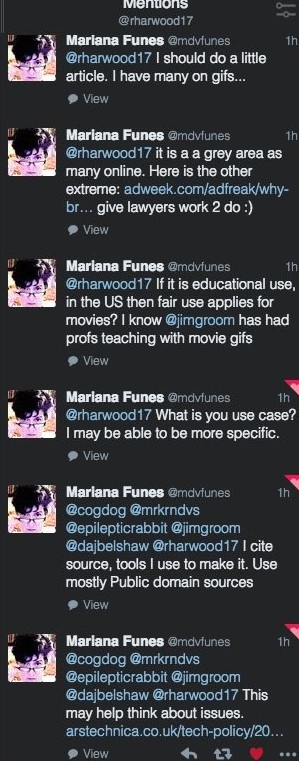
But then I started wondering about citations and fair use for animated GIFs made with copyrighted material.  Enter my PLN.

//platform.twitter.com/widgets.js

//platform.twitter.com/widgets.js

and finally…

PLN Helping


That was only a portion of the conversation.  Ideas and thoughts continued to trickle in over the course of a couple of days.  It turns out there’s a lot of grey around the idea.  No one had a clear answer.  In the end I decided to steer clear.

My Connection

Over the past two years I’ve also continued my work developing the #AfricaEd chat.  Its been an up and down experience for sure.  There have been weeks where I felt like the whole world was chiming in on our conversations and others when it was just me and the crickets.  But that’s part of the growth right?  If it was easy all the time, it wouldn’t be a challenge, we wouldn’t learn from it and everyone would host their own chat.

Figuring out what the hot topics are and what topics are really meaningful is a big challenge.  There are lots of feel good chats out there that allow teachers to pat each other on the back and talk about how great they are.  I’m hoping to create a bit deeper conversation about best practice and the changes that need to occur.  Then discuss how we make that happen.  Sometimes it works, sometimes it doesn’t.  Some weeks I’m sure I’ve got a winner and it just doesn’t go anywhere.

Today was a good one though and #coetail even got several mentions. It may have only been three or four of us in the conversation but it was quality and how else do you have a semi-asynchronus conversation between Ghana, Kuwait, Qatar and Ethipoia?

So where does this leave us? For one it leaves us quite connected.
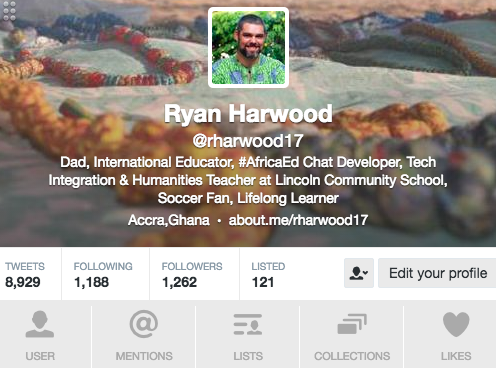
My Profile
My Profile

I’ve got over a thousand colleagues at my finger tips (ok, some of those might be sports stars and musicians and such) to confer and with which to  learn.

But most importantly, I think it leaves us happy, well rounded and with friends from around the world.


Oh, and then there’s this. I had to have one GIF after all that conversation…

Taking a brain break


Bridge Over Troubled Waters

Its always a challenge to work on a project that relies on creating a project with others that will be completed by someone else who has to ask another group for their participation in order to complete the project.  Huh?

It creates a bit of a tangled web of planners, participants and producers that looks something like this chart. http://popplet.com/app/Popplet_Alpha.swf?page_id=3135521&em=1

Photo By Me
Photo By Me

The ship was feeling a little crowded and seemed to be drifting at sea from time to time in search of land.   But, I think it has finally righted itself and we are headed for open water.  We’ve passed through the Straits of Longterm Digital Storage Solutions, made it through the Doldrums of Spring Break and Conferences and are entering the Seas of Productivity.

The students have been working on developing their recording and storytelling skills along the way through a series of assignments adapted from the Out Of Eden Learning project that my colleague Andy has been using in his 6th grade classes, the #HearMyHome project, that I stumbled upon on Twitter and had hoped to have our classes participate in but didn’t find the time, and of course our own amazing imaginations.

As you can see below, students have started sharing some of their work as a way to introduce themselves to our audience.
//padlet.com/embed/hq7mtzxqkxs3

The process has been a bit of a struggle as we’ve been waiting on our IT department to set up some server space to ensure long term storage for our content.  You see, I realised as this project got underway for the second year, that all of the audio from last year’s interviews was linked to individual student’s Google accounts.  Rookie mistake.  I’m in the process of downloading all of the audio and making copies of their documents so that parts don’t begin to disappear as students leave and their accounts are disabled.

It has been a bigger challenge than it seems it should be to develop not only a storage solution, but a work flow that makes sense as well.  We went through several different scenarios that would have required uploads, changing of ownerships and multiple account managements.  I’m all for helping students develop their tech skills, but with each step that is added to the process the chances of something going wrong increases.  We needed a way to create URLs to link images and audio to our site and to the maps that we are creating.

As you will find if you start clicking around on the map, some students found ways to embed their info and images and others just added a link. We want to develop a little more consistency, and now that we have a storage solution, I think we can. Eventually this map will include layers of audio and photo content created by the students about their own communities.

We start recording interviews next week and that’s when the real work begins. I’m excited.


Turn, Turn, Turn

Life is a process of change. Without change, life is impossible.  Once you accept that with joy, there is no fear. – Thich Nhat Hanh

flickr photo by Moyan_Brenn https://flickr.com/photos/aigle_dore/7912377858 shared under a Creative Commons (BY) licenseI came across this quote in the past couple of weeks and as I was planning today, it popped back into my head.  If we substitute “teaching” for “life” I think it sums up our jobs.  I’ll be honest here, the planning part has never been my biggest strength.  I like to work in the moment with rough outlines and ideas.  I’m not going to claim that I do this without fear, but I do feel that it has made me a better teacher.  I’ve grown to be ok with the days that the lesson doesn’t go quite as planned or when we spontaneously take a 10 minute break to watch the sandstorm that just swept over our campus.  

The winds of change are blowing all over this final project.  I thought I had a fantastic plan nailed down for our oral history project this year, but I keep coming up with ideas I want to try out.  Oh, and I’m working with another humanities teacher this year so as I bounce those ideas off of him, he inevitably has some ideas of his own.  He’s also participating in the Out of Eden Walk project with his sixth grade class, which brings new ideas to the table almost weekly.  So although the process might not be as streamlined as I’d thought it was.  I think its developing into a pretty cool project.

0075 TimeThere’s also been the issue of time in the classroom.  Our transition to this unit almost perfectly aligned with my trip to Mumbai for ASBUnplugged.  So I had a day to introduce the concepts and beginning activities and then had to leave my students to their own devices and at the mercy of a substitute.  We have this week to sort things out, and then we’re on Spring Break.  I may not be exactly where I want to be on this project, but I’m not afraid.

Here’s some of the highlights of the plan in process. Feel free to weigh in with your thoughts in the comments

  • students collect photos, videos, audio recordings and journal entries of their own experiences as a teen and a student
  • these are shared via Padlet or ThingLink to encourage conversation and reflection
  • students use their peers’ photos, audio, video, to create a story of being a teen living in Ghana and attending LCS
  • students interview LCS staff and teachers about their experiences as teens and in school.
  • QR codes of teacher interviews will be placed around the school, possibly on teachers’ doors to share the interviews
  • students reflect on the similarities of their teachers’ experiences with their own
  • students reflect on the advantages and limitations of this type recorded history

I’d love to attach the day by day plan here to show you how perfectly organised it is and how nicely I see it flowing, but as they say here in Ghana, “Please. It is coming.”


flickr photo Meditation by Moyan_Brenn  shared under a Creative Commons (BY) license

flickr photo 0075 Time by Mark Morgan Trinidad A  shared under a Creative Commons (BY) license


Let’s Get It Started

Its time to really start thinking about this project and getting things rolling.  Actually, I’ve been thinking about it for while, I just need to start taking some action.

Here’s an outline of my plan. I’m hoping to drastically improve last year’s oral history project that I started with my 8th grade humanities class.  It was a mild success last year, but it I walked away from the project with lots of thoughts on how to make it better.

microphone-307365_1280This year we’ll be adding a few more elements to the project that will hopefully make it more meaningful to not only the students participating, but to the community of our school as well.  The basic plan is for our students to collect stories from the staff at Lincoln Community School about their teenage years and educational experience.  We’re hoping to build a collection of stories of youth around the world and throughout different eras of history.  Our staff, like our students, is quite diverse and should provide an intriguing array of stories.

The project is part of our service learning initiative at LCS as we ultimately share this collection of recordings on a website that I created last year for this purpose.  I’m also considering giving students the option to work on redesigning the website or looking for ways to enhance it as part of the project.

I plan on beginning the project by tapping into another project that I stumbled on via Twitter.  The #hearmyhome project closely relates to some of what we are hoping to do ourselves and will provide students with an opportunity to practice recording, finding stories to share and challenging their creativity.  The hope is once we get to the point of interviewing teachers, the students will be somewhat comfortable with the process.

Throughout the project I want students thinking about several things.  One of the top ideas being: How and why is history recorded?  One of our first activities will be a reflection on a house color event we had last week.  Students competed in an obstacle course, tug of war and jump roping to earn points for their house.  We’ll use the reflection to open a discussion on perspectives and details in a story.  In a moment of what was hopefully genius, I decided, while they were sharing their stories, to ask them to go home and record their stories so that we can begin the work of creating good recordings, and telling stories.  We’ll see how this turns out.

//platform.twitter.com/widgets.js
 

Let's Get It Started

Its time to really start thinking about this project and getting things rolling.  Actually, I’ve been thinking about it for while, I just need to start taking some action.

Here’s an outline of my plan. I’m hoping to drastically improve last year’s oral history project that I started with my 8th grade humanities class.  It was a mild success last year, but it I walked away from the project with lots of thoughts on how to make it better.

microphone-307365_1280This year we’ll be adding a few more elements to the project that will hopefully make it more meaningful to not only the students participating, but to the community of our school as well.  The basic plan is for our students to collect stories from the staff at Lincoln Community School about their teenage years and educational experience.  We’re hoping to build a collection of stories of youth around the world and throughout different eras of history.  Our staff, like our students, is quite diverse and should provide an intriguing array of stories.

The project is part of our service learning initiative at LCS as we ultimately share this collection of recordings on a website that I created last year for this purpose.  I’m also considering giving students the option to work on redesigning the website or looking for ways to enhance it as part of the project.

I plan on beginning the project by tapping into another project that I stumbled on via Twitter.  The #hearmyhome project closely relates to some of what we are hoping to do ourselves and will provide students with an opportunity to practice recording, finding stories to share and challenging their creativity.  The hope is once we get to the point of interviewing teachers, the students will be somewhat comfortable with the process.

Throughout the project I want students thinking about several things.  One of the top ideas being: How and why is history recorded?  One of our first activities will be a reflection on a house color event we had last week.  Students competed in an obstacle course, tug of war and jump roping to earn points for their house.  We’ll use the reflection to open a discussion on perspectives and details in a story.  In a moment of what was hopefully genius, I decided, while they were sharing their stories, to ask them to go home and record their stories so that we can begin the work of creating good recordings, and telling stories.  We’ll see how this turns out.

//platform.twitter.com/widgets.js
 

It Takes Two

Sometimes the first idea is a good one, but not the right one.  It turns out my plan for course 5 wasn’t quite on track so here’s a remix.

This will be the second year my classes have worked on an oral history project as a service learning and cross-curricular unit.  It went well last year, but as with any first time project, it could use some tweaking.

Why do you think this unit is a good possibility for your Course 5 project?

Last year the project incorporated several different types of digital storytelling.  However they were not fully developed ideas and were put together as we went along.  The students created a “day in the life” Google Slides presentation based on their social media use as well as a video with audio clips from their interviews that was supposed to link the ideas with images of the area being discussed.  I think that this time around each of these aspects of the unit can be drastically improved based on the learning from Course 3 around infographics and digital storytelling.

What are some of your concerns about redesigning this unit?

Its always a challenge to redesign a unit, but this year I also will have a new language arts teacher to collaborate with as well as an additional humanities teacher working along side me.  It can be a little more difficult to get my own vision for a project completed when collaborating.  I’ll add that I still haven’t met the new language arts teacher as she was an emergency replacement over the winter break.

Other than the human element, time is always an issue.  I felt like the project was rushed last year even though we spent over four weeks on it.  Time is always hard to carve out of a school year when you are working across curriculums.  We’ll see how it goes.

What shifts in pedagogy will this new unit require from you?

I think one of the main shifts I’ll have to make is in my planning stages.  I tend to like working in the moment, but with the way things are shaping up here and in order to work with multiple teachers, I’m going to have to buckle down and really map this thing out.

I also want to make sure that we focus on teaching the technological skills that the kids need.  Too often, we assume that students are experts with whatever technology we throw at them.  This time around I want to make sure that I work in little tutorials and work sessions for the varying platforms or programs that we ask them to use.  I’d love to see these be student driven where they teach each other or take turns sharing tips.

What skills and/or attitudes will this new unit require from your students?

I think this unit will really push the students out of their comfort zones.  It requires them to go out and talk to adults that they don’t usually interact with and really think about the questions they are asking.  They have to learn to ask probing questions instead of yes and no questions and figure out how to get people talking to them and not just answering questions.  Just as I stated for myself, they also have to really think about their deadlines and working with others.  Group work is hard and they’ll have to figure out the best ways to collaborate, and the best partners with which to work.

Below is the updated version of last year’s unit plan.  I’ll be annotating as I go along this year as I make improvements and changes.  This way you can follow along live, kind of like a stat tracker for your favorite ball game.  Exciting huh?

Tell Me What You See

I think I’ve mentioned before that I’m in the midst of a transition from a classroom teacher to a full time Technology Integration Coach position.  I’m currently splitting my time between the two jobs.  I’m excited about the change, but it poses a challenge for my focus on the course 5 project.  I could go about my usual business and rework a unit I”m going to do with my students in the next semester, but it would potentially be a one shot deal.  I’d do a lot of reworking, only to use it one time.  Of course the benefit to the students is there, but I’m trying to look long term at my work as well.

My other option is to focus on what I’ll be presenting to teachers in the coming year.  I’ve embedded my almost complete UBD planner below and I would love your feedback.  Its a completely new project, so I’m not technically redesigning anything, but it seems to make sense to use this opportunity to get a head start.

Going this route with my project will present some challenges.  First, I want to make sure that I’m creating professional development that is beneficial for my colleagues.  I want to incorporate the same ideas I would use in my classroom to make sure that teachers are engaged, social and learning.  I can’t stand when we don’t practice what we preach in professional development.

Second, its not your typical unit of study.  I’m tasked with making sure all teachers in our school are effectively using our learning management system, ManageBac.  Some teachers have been using it for years and there will be others who have never heard of it.  So far, I’ve essentially been flipping the learning as I’ve produced mini tutorials as teachers ask questions and I plan to continue to utilize these in my plans.  The key will be how to roll it all out.

I’ve also got to remember that I’m dealing with teachers now.  I have to be aware of the vast differences in experience, comfort with technology, attention span… Wait a minute.  That’s pretty much the same as a classroom.  So maybe that’s not as big a deal.

A big part will be working to get my teachers to buy in to the work of building their collective skills within ManageBac.  I have to be able to sell it as an important part of teaching and learning with an end goal of improving student experience.  I’m contemplating the idea of using badges within the school for this and a few other projects in the works.

I’m excited about the challenge and I like the idea of looking at it through the backwards design process.  I have ideas about how to approach the training, but I’m not sure they all fit into the UBD planner.

Your comments and ideas are more than welcome.  Thanks!

Glory Days

It is interesting to take a few minutes out to reflect on my own use of “devices” in the classroom as I enter a transition period from a classroom teacher to a technology integration coach.  I’ve always been the informal “techie” guy in my schools.  At one point I actually made some fake billing documents to send my peers when I helped them with their VCRs and frozen computer screens.  Now I’m in what might be my last year in the classroom for awhile.  A good time to reflect.

Interestingly enough, I’m probably at the lowest level of device use that I’ve ever had.  Ironic, as I’m in a private international school with a bring your own device program instead of a public school in the States.  I currently rely primarily on student laptops and a projector as my devices.  I have access to a Mimio board, but even with strategically applied tape to the cord, it doesn’t quite want to work.

Device LoveIn the past I’ve had iPods, iPads, and an ActivBoard (I miss you buddy) with which my usage was approaching somewhat of a Jedi Master level. I had kids creating podcasts, movies, App Smashing, before I knew what that even was, and enjoying some very interactive classes thanks to the ActivResponse units (dubbed OrangeBerries by my students).

I was also in on the ground level of getting all of this technology in our school in varying ways.  From just making a good case for the technology to winning multiple grants and purchasing the iPads for my own classroom, I was definitely pushing for something new in our school and leading the way for those around me.

My current school has iPads, but they’re housed in the library on the other side of campus.  Out of sight, out of mind.  I think this might be the time to start thinking about how I can reintegrate them into my classes to rebuild some of my street cred as a tech coach.  We all know there’s nothing worse than the guy coming in to help you and telling you all about the things he used to do five to ten years ago.Thinking
I have one more semester in the classroom before I transition into my new role full time.  I’m going to use this semester to really think about how to use what is available at our school for the most benefit of my students.  In the past I may have been working to fit the lesson into the technology.  Over the years, I’ve learned this obviously isn’t the best way. I’m excited to challenge my self here and see how I have grown in my use of devices in the classroom.


flickr photo Device Love by lukew  shared under a Creative Commons (BY) license

flickr photo Thinking: More Than None Will Be Required by Digital Sextant  shared under a Creative Commons (BY) license

All Along the Watchtower

I certainly hope that “education as we know it” will have changed in the next decade.  Although it has certainly struggled to do so over the past 100 years.  There is no doubt that technology has played and will continue to play a part in the development of education.  It would be difficult for it not to in some way.

The Talk

Screenshot by Me
Screenshot by Me

There are increasing conversations around what needs to change in our systems and it seems that technology is always a part of the conversation.  I stumbled on a prime example via Twitter just a few weeks ago as a group was using the hashtag #cuerockstar to discuss learning at a conference being hosted at Skywalker Ranch.  I’m pretty sure this guy knows a thing or two about the benefits of technology in the classroom.

Our world is increasingly reliant on technology and computers making it essential that not only technology be used in the classroom, but students are taught how to use various forms of technology and even how to make computers work.  Late night codingIf we think about how deeply technology is embedded into our society  (raise your hand if you get paid electronically) there is no reason to even argue about the concept of technology in the classroom.

Now if we are talking about how that technology is used, it is a different story.  Hopefully we are all aware that tech for the sake of having tech is ridiculous.  But as we start using technology to create connections around the world and share our teaching and learning experiences with others, it becomes a powerful tool.

The Future

I don’t think that the classroom of the future will exist without teachers as some seem to envision, but I do hope that it will be a much more collaborative space.  I hope that it will encourage a global mindset and challenge students to create and solve problems.

As I work to move from a classroom teacher to a tech coach, I’m certainly thinking not only about how to push teachers to see these concepts, but how I will use them in my own offerings of professional development.  These changes can’t come from a top down approach, they need to come from within the walls of our schools and the halls of our universities.

The Dream

496px-Full_Sunburst_over_EarthIf we are talking about the perfect classroom for creating real change in the world and developing true understanding of cultures and global issues,  I think this school has a pretty good idea.  How beautiful would it be for every kid to have a chance like that?


Image Source

Late Night Coding photo by jjackowski   Creative Commons (BY-NC-SA) license on Flikr

Full Sunburst over Earth” by NASA. Original uploader was Mrshaba at en.wikipedia – File:Robot Arm Over Earth with Sunburst – GPN-2000-001097.jpg. Licensed under Public Domain via Commons –


Question the Answers

Readings for this week were interesting and I’ll offer some brief thoughts before I get to my learning protein.

I’m not a fan of the flipped classroom approach.  I think work at home of any sort is a challenge as there are innumerable variables that students face.  I prefer to keep as much work in class as possible and I’m skeptical of these numbers as they might apply to a larger scale.

Gamification has potential.  I’ve tried it in the past with minor success, but unfortunately it was not a sustainable model.  It was pretty much a ton of worksheets that earned points for a game.  Not much connection there. I was learning about the processes though.  I’m honestly not sure if the kids were learning much along the way.  Sorry guys.

Play. Yes. There should be more play associated with school.  Anything from game based learning to the practice of playing with ideas and tools in a somewhat structured environment is crucial to student engagement.

But here’s the one idea that got me going.

This week I’m pumped about finding my next read. As I read through an interview with the authors, I found so much that just made sense.  My favorite statement from the article was:

inquiry is not about asking a “right” question, but it is a process of asking increasingly better questions

flickr photo by Marco Bellucci http://flickr.com/photos/marcobellucci/3534516458 shared under a Creative Commons (BY) license

This made me stop for a few minutes to reflect on my own practices. I’m constantly telling kids in class and parents in conferences that the most important part of a student’s learning development is to ask questions.  Now I have to really stop and ask myself, am I helping them do that?  It definitely isn’t enough to simply ask, “Any questions?” and listen to the crickets that follow.  I need to change my approach.

I may have actually stumbled into a decent implementation of this idea with tomorrow’s assessment.  Students are debating if a recent event was actually a political revolution.  The assignment requires them to be prepared to argue yes or no or to be the moderator asking questions.  This required them to know not only the facts behind the event, but determine an acceptable definition of political revolution and develop questions that would help each side prove their point. 17031588420_c1d52a70dd_z

Students struggled at first.  Ironically enough, I find that research is not a strength among students in this age where all of the information is literally at their fingertips.  Once we got that sorted and students began to practice each role, they were coming up with some good arguments and questions.  I’ve been somewhat hands off letting them figure it out and I’m excited to see what tomorrow and Tuesday will bring.

Lincoln is an MYP school which means inquiry is an important part of our curriculum.  I  now I have  a new way of looking at what that really means.  I’m looking forward to challenging myself and students with a new outlook on the importance and value of a good question.

Question Mark by Marco Bellucci Creative Commons Licensed on Flickr
10 Reasons Why You Should Use Google Hangouts For Your Business by Joe the Goat Farmer Creative Commons Licensed on Flikr